What we measured
This page reports a measurement, not an opinion: out of 10,000 freshly generated boards at each standard difficulty, how many can be cleared using logic alone? A board counts as logic-only when the solver clears it without ever guessing — every revealed cell is provably safe in every mine layout consistent with the numbers on screen, and every flag is provably a mine in every such layout. The generator, the opening and the solver are the same code the game on this site runs, so the numbers describe boards you will actually see.
The result: guessing gets much worse with difficulty
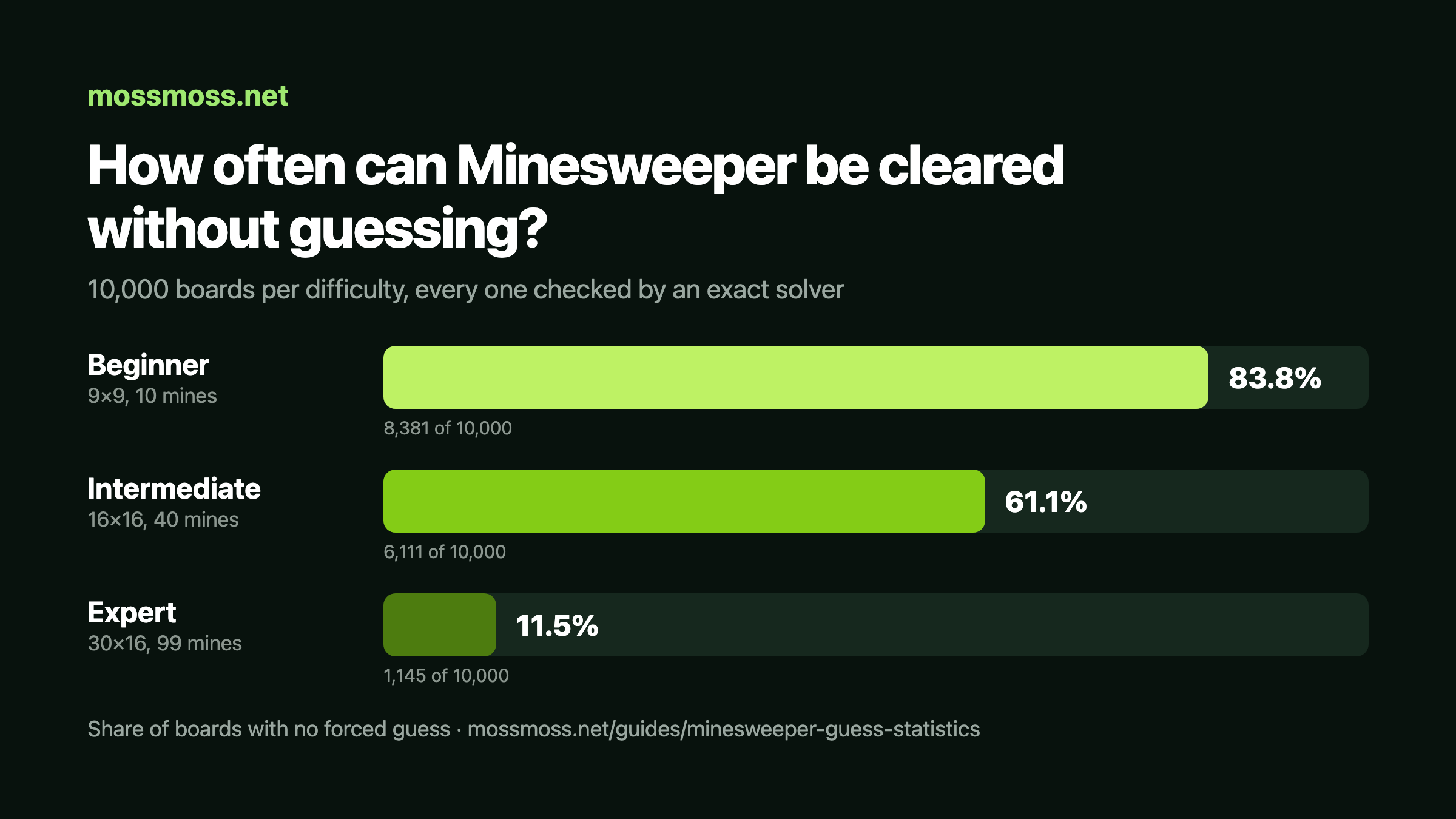
The pattern is stark. On Beginner boards a guess is the exception; on Expert boards it is the norm. The numbers below are counts out of 10,000 boards per difficulty, opened at the centre exactly as the game opens them.
| Board | Cleared by logic alone |
|---|---|
| Beginner 9×9, 10 mines (12.3% mine density) | 8,381 of 10,000 — 83.8% |
| Intermediate 16×16, 40 mines (15.6% mine density) | 6,111 of 10,000 — 61.1% |
| Expert 30×16, 99 mines (20.6% mine density) | 1,145 of 10,000 — 11.5% |
Why Expert boards so often need a guess
Mine density rises from about one mine in eight cells on Beginner to about one in five on Expert. Higher density does two things at once: it creates more separate frontier groups that each need their own proof, and it leaves fewer empty regions to open, so there are fewer numbers to work with. The solver can prove a cell only when every consistent layout agrees about it. With more mines packed into the same neighbourhood, more layouts survive every counting rule, and the positions where they disagree grow.
The same boards, measured in 3BV
3BV is the minimum number of left clicks needed to clear a board if every click were optimal, so it is the fairest way to compare board difficulty across sizes. The same 30,000 boards produced these ranges. The spread matters as much as the median: two Expert boards can differ by more than a hundred clicks.
| Board | 3BV median (mean · range) |
|---|---|
| Beginner 9×9 | 14 (14.2 · 2–33) |
| Intermediate 16×16 | 62 (63.1 · 28–111) |
| Expert 30×16 | 170 (170.5 · 109–248) |
What this means for No-Guess mode
No-Guess mode on this site throws away any board the solver cannot clear by logic and generates another one from the same seeded stream. This study shows why that matters: on Expert, roughly eight or nine out of every ten standard boards would have forced a guess somewhere, and a single unlucky 50/50 ends the run regardless of skill. A No-Guess board is not an easier board — it is the same game with the coin flips removed.
Limitations worth knowing
Three limits keep these numbers honest. First, every board is opened at the centre, as the game does; a different first click would change the opening and therefore the rates. Second, the solver is strong but not omniscient: it applies counting rules, the global mine count and exhaustive enumeration of connected frontier groups, and a different solver with additional inference rules could clear a few more boards. Third, the boards come from a fixed seed set, so these are exact counts for these 30,000 boards rather than a proof about every possible board.
Check the numbers yourself
The raw results, including the method string and the per-level counts, are published as JSON. The script that produced them is part of the same open-source engine repository, so anyone can rerun the study with a different sample size and compare.
- →Raw data: mossmoss.net/data/no-guess-study.json — 30,000 boards, 10,000 per difficulty.
- →Script: study.mjs in the open-source engine repository; run node study.mjs 10000 to reproduce the counts.
- →Engine: the same generator and solver are published on GitHub and used by the game on this site.
Play Minesweeper online
Everything above is playable right here in the browser. No download and no account required.
Start playing →Frequently asked questions
What percentage of Minesweeper boards require a guess?+
In our measurement of 10,000 boards per difficulty, 16.2% of Beginner boards, 38.9% of Intermediate boards and 88.5% of Expert boards could not be cleared by logic alone and required at least one guess.
Why do Expert Minesweeper boards need guessing so often?+
Expert boards have 99 mines in 480 cells, about 20.6% mine density, compared with 12.3% on Beginner. Denser mines create more ambiguous frontier positions where several mine layouts fit the visible numbers and disagree about a covered cell.
Does No-Guess Minesweeper make the game easier?+
No. The board size and mine count are identical. No-Guess mode simply regenerates boards that cannot be solved by deduction, so a run is decided by reading the board rather than by a coin flip.
What is 3BV and what is a normal value?+
3BV is the minimum number of left clicks needed to clear a board. In our sample the median was 14 for Beginner, 62 for Intermediate and 170 for Expert.
How was the study run?+
Each board was generated from a fixed seed with the site's own generator, opened at the centre like a real game, then solved by the site's constraint solver. A board counted as logic-only when the solver cleared it without guessing.
Can I reproduce these numbers?+
Yes. The raw JSON is published at /data/no-guess-study.json and the script that produced it is in the site repository; it accepts a sample size argument.